Ball Sort Game - Color Puzzle
- 4.9
- Rating
- 1.00M
- Installs
- Free
- Price
 Analysis by App-foxy
I spent time with Ball Sort Game - Color Puzzle, a free puzzle game from Words Mobile, and found it easiest to describe as a quiet sorting exercise that gradually asks more from your attention. The idea is immediately understandable: colored balls are placed in tubes, and I move them until each tube contains one color. There is no complicated story to learn and no long tutorial to get through, which makes it the sort of game I can open for a short break without preparing myself for a major session.
That simplicity is also the main reason it works. I do not need fast reactions, a large screen, or previous puzzle experience. I only need to look carefully, plan a few moves ahead, and accept that a seemingly harmless transfer can close off the rest of the board. The game belongs to the casual brain puzzle side of mobile gaming rather than the competitive or action-heavy side, and its appeal comes from making a small space feel mentally meaningful.
How the sorting puzzles feel in everyday play
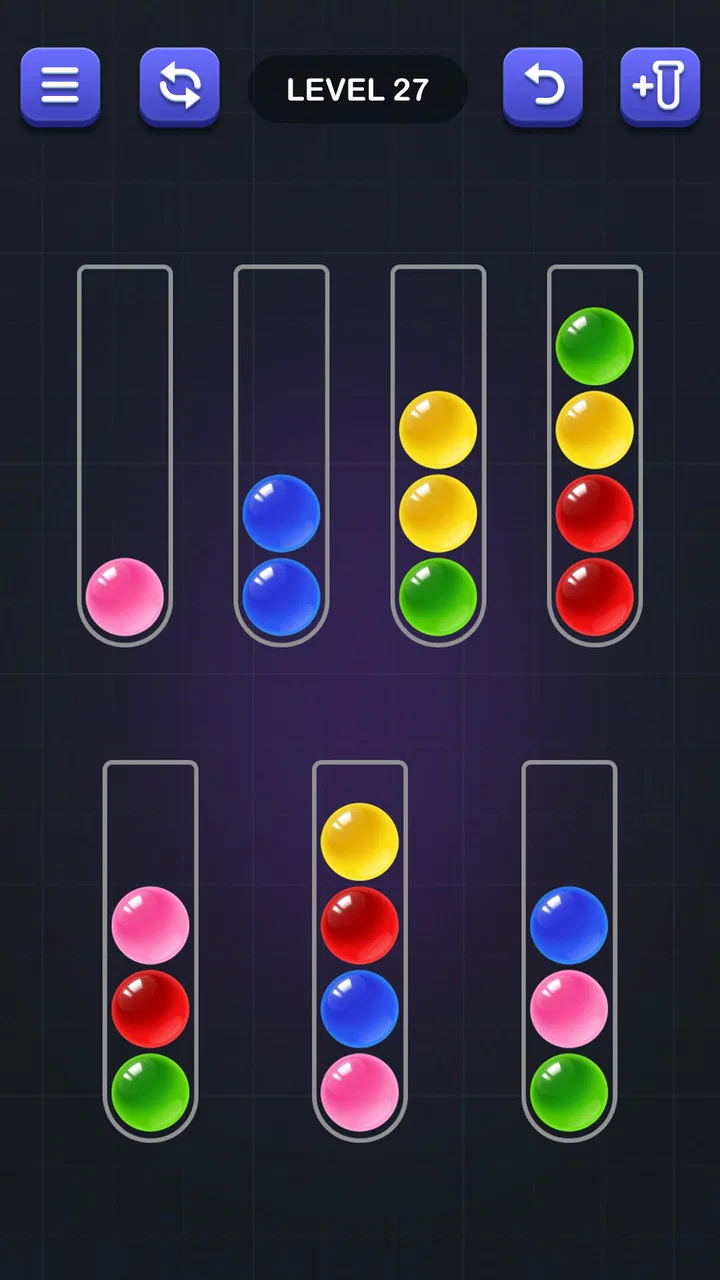
Each round gives me a group of tubes and balls arranged by color. The basic action is familiar within seconds: select a tube, choose another tube, and transfer a ball when the arrangement allows it. The objective is not merely to move pieces around, but to create a sequence that leaves enough room for later decisions. A color may be visible at the top of one tube while the matching balls are buried elsewhere, so the obvious move is not always the useful one.
You May Also Like

 Blood Strike: 2.5 Anniversary
Blood Strike’s Loadouts Turn Every Drop Into a Tactical Gamble
A close look at Blood Strike’s custom loadouts: how fast access to signature weapons reshapes its battle royale rhythm, rewards preparation, and narrows the gap between fights.

 Pandora - Music & Podcasts
Pandora’s Music Is Easy to Start, but Harder to Recover
Pandora’s strength is its low-effort path from a seed to a station. Its weak spot is how much confidence it asks you to place in connection, setup, and quiet recovery.

 8 Ball Pool
 Is Built on Rivalries, Rematches, and Routine
A close look at the rivalries, rematches, shared routines, and unanswered safety questions that turn a quick pool match into a persistent mobile community.

 Samsung Music
’s Quiet Strength Is Playing What You Already Own
Its reach comes less from spectacle than from dependable access to a personal library. That simplicity is both the app’s strongest retention engine and its ceiling.

 AccuWeather: Weather Radar
AccuWeather Review: A Quick, Clear Forecast for Everyday Decisions
For everyday plans, the best forecast is the one you can understand quickly. AccuWeather makes rain timing, radar, and local conditions easy to act on, with a few trade-offs.

 Hill Climb Racing
Why Hill Climb Racing Still Turns Crashes Into One More Run
A tiny car, a bumpy hill and one more upgrade: Hill Climb Racing keeps resurfacing because its simple chaos makes every near-miss feel personal.
More From Our News Desk



I like that the game turns a very small rule set into a planning problem. At first, I can solve a board by following the clearest matches. Later, I have to think about empty space as a resource. An unused tube is not just a convenient place to put a ball; it can be the difference between keeping the puzzle open and trapping several colors behind the wrong stack. That makes the game more thoughtful than its short store description suggests.
The experience is best suited to relaxed attention. I can play while waiting for an appointment, during a short commute when I am seated, or at the end of the day when I want something more engaging than scrolling. It does not demand the constant focus of a timed arcade game, but it also does not become completely passive. My hands perform simple taps while my mind checks the consequences.
A useful habit is to pause before making the first move. I look for tubes that already have a useful color at the top, identify the emptiest spaces, and decide which color is most dangerous to disturb. This small inspection often prevents the common mistake of moving a ball just because the destination is available. In this game, an available move and a good move are very different things.
Why the rule is easy but the decisions are not
The accessible controls make this a comfortable choice for people who do not normally play puzzle games. There are no complicated gestures to memorize, and the goal remains visible throughout the round. Someone can understand the objective by watching a single board for a moment. That clarity matters on a phone, where a game that requires too much explanation is easy to abandon.
Still, the simplicity should not be confused with a lack of challenge. The main difficulty comes from ordering. If I combine two matching balls too early, I may hide a ball needed elsewhere. If I use an empty tube without considering the next color, I can lose the flexibility that made the board solvable. The game rewards restraint, especially when a move looks satisfying but does not improve the overall position.
One of my favorite ways to approach a difficult board is to work backward from the colors that are most buried. Instead of starting with the easiest visible match, I ask which tube must be opened first and where its contents can temporarily go. This turns the round into a small logistics problem. It is a more reliable method than tapping through possibilities randomly, and it gives the game a satisfying sense of structure.
Another practical tip is to avoid filling an empty tube completely unless I know why that stack is useful. A full tube can look like progress, but it may remove a valuable buffer. Leaving a space available often allows a later color to be separated cleanly. This is the kind of lesson that becomes apparent through play rather than through the short store summary, and it is where the puzzle starts to feel genuinely strategic.
What the free price means for its value
The game is available for free, so the basic decision is straightforward: I can try it without committing money. That makes it easy to recommend as a low-risk download for anyone curious about color-sorting puzzles. The free entry point is especially useful for occasional players who may only open the game for a few minutes at a time and do not want to purchase a larger premium puzzle experience before knowing whether the format suits them.
At the same time, free access does not automatically make every aspect of the experience valuable. The real question is whether the rounds remain pleasant enough to justify the space on my phone and the attention they request. For me, the answer depends on what I want from a game. If I want a calm, repeatable mental activity, the no-cost access is attractive. If I want a rich narrative, unusual mechanics, or a carefully authored campaign, this is a much narrower proposition.
I would not judge it by the standards of a paid, story-driven puzzle game. Its value comes from convenience and repeatability rather than presentation or depth of world-building. A free game can be worthwhile when it fills a specific small need, and this one fills the need for a quick sorting challenge without asking me to learn a broad system first.
The game has an average rating of 4.9 from around 64 thousand ratings, and it has passed one million installs. Those figures suggest that the straightforward format has found a substantial audience, although popularity does not remove the personal trade-off: players who dislike repeating the same kind of spatial task may lose interest even if they appreciate the first few rounds.
The strengths I noticed after more than a quick trial
The strongest quality is its low friction. I can begin a round almost immediately, understand what I am looking at, and stop when I need to do something else. That makes it more practical than many mobile puzzle games that surround a simple activity with layers of menus, stories, upgrades, or daily obligations. Here, the central action stays in view.
I also appreciate the way it supports different levels of concentration. I can solve an easy board casually, but a more crowded arrangement asks me to slow down and map out possible transfers. This gives the same basic format more than one use. It works as a brief distraction, yet it can also occupy a longer quiet period when I want to think through a problem without pressure.
For families, the Everyone content rating makes the game approachable across a broad age range. I would still expect younger players to benefit from occasional guidance, not because the rule is difficult, but because planning several moves ahead can be less natural than simply matching visible colors. An adult can explain the importance of keeping an empty tube open, after which the child can start experimenting independently.
The current version is 5.0, and the game supports devices running Android 5.0 or later. That broad system requirement makes it relevant to people using older Android hardware, although actual comfort will still depend on the phone’s screen size and responsiveness. On a small display, closely grouped tubes may require more careful tapping, especially when I am trying to select a particular stack quickly.
The trade-offs that may change your mind
The biggest limitation is repetition. The color-sorting rule is clean, but it is also the entire identity of the game. Players who need constant novelty may find that the satisfaction fades once the basic pattern becomes familiar. This is not the right choice for someone looking for wordplay, physics experiments, a narrative mystery, or a puzzle collection with several unrelated systems.
There is also a difference between relaxing and effortless. A board can begin calmly and then become surprisingly demanding when I have used the spare space poorly. That tension is enjoyable when I am in the mood to think, but it can feel frustrating if I only want a completely mindless break. The game is gentle in presentation, yet the decisions can still punish careless play.
Another trade-off is that the format offers limited social motivation. I do not choose it when I want to compete directly with friends or share a dramatic moment. Its reward is personal: I see a messy arrangement become organized because I planned correctly. Players who enjoy leaderboards, multiplayer matches, or visible progression may prefer a different puzzle game with stronger competitive or collection-based systems.
I also recommend being patient with misclicks. On a phone, a quick tap can select the wrong tube, particularly when several containers are close together. The safest approach is to slow down during crowded positions and confirm the destination before committing. This is a minor issue, but it matters because one accidental transfer can change the logic of the board.
For someone deciding between this and a paid puzzle title, I would frame the choice around purpose rather than price alone. The free option is useful for short sessions and uncomplicated mental exercise. A paid alternative may be better if I value polished presentation, a fixed campaign, unusual puzzle rules, or a more curated sense of progression. Ball Sort Game - Color Puzzle earns its place through accessibility, not through trying to replace every other type of puzzle.
Who will get the most from it
I think this game is a good fit for people who enjoy organizing patterns and solving problems at their own pace. It is particularly suitable for players who want something they can understand immediately but still revisit when they have a few spare minutes. The lack of a complicated premise makes it easy to share with a family member who is not a regular mobile gamer.
It can also work well as a transition activity between tasks. For example, after finishing work, I might play a single round before moving on to dinner or another responsibility. The board gives my attention a clear target, which is more satisfying than aimlessly switching between apps, while the short-session structure makes it easier to stop than a game built around continuous matches or unfolding stories.
Students and office workers may appreciate the way it encourages a brief change of mental mode. I would not call it a productivity tool, and it should not replace proper rest, but a small logic challenge can feel more refreshing than another stream of notifications. The key is to use it deliberately: one or two focused rounds are more useful than opening it automatically whenever there is a moment of boredom.
I would suggest skipping it if you already know that sorting games quickly become repetitive for you. It is also a poor match for anyone seeking fast action, deep character development, or a large range of puzzle types. Even though it is free, downloading it is not automatically worthwhile if its central mechanic holds no appeal. A different puzzle app with word clues, numbers, or physics-based interactions would provide more variety in that case.
My practical approach to difficult boards
When a position starts to look tangled, I stop treating every tube as equally important. I first identify the tube whose top color can be completed with the fewest disruptions. Then I check whether completing it will expose a useful color or merely create a full stack that blocks access. This distinction helps me avoid making progress that is visually pleasing but strategically empty.
I also try to preserve at least one flexible space whenever possible. That space lets me separate a mixed stack, uncover a hidden ball, or postpone a commitment until the board becomes clearer. If every empty tube is filled with a different color, the puzzle can become much harder even when several pairs are technically available. Thinking about future access is more important than maximizing immediate matches.
Finally, I treat an apparently bad position as a lesson rather than a reason to rush. I review the last few moves and look for the point at which I used a buffer too early or covered a color that needed to move. This makes retries more useful. The game’s best mental payoff comes when I understand why a plan failed and solve the next attempt with a better order, rather than simply trying random transfers.
That method also answers a common concern about difficulty: the game is approachable at the start, but success later depends on planning rather than speed. If I am willing to pause and inspect the board, I can usually make more progress than by tapping quickly. Players who prefer immediate, instinctive solutions may find this slower style less appealing, while careful thinkers will likely enjoy the control it gives them.
My verdict on downloading it
Words Mobile has made a focused puzzle game that understands the benefit of keeping its central idea clear. The free price makes trying it easy, the Everyone rating keeps it broadly approachable, and the color-based sorting rule is simple enough for a first-time player to grasp. Its strongest use is as a calm, compact activity for moments when I want to exercise my attention without starting a large game.
My recommendation comes with a clear boundary. I would choose it for short solo sessions, gentle planning, and the satisfaction of turning a disordered board into a clean result. I would skip it if I wanted story, social competition, rapid action, or a constantly changing set of mechanics. The game does not need to be more than it is, but that also means its appeal depends heavily on enjoying this one kind of puzzle.
For me, the most convincing value is the combination of immediate access and enough strategic friction to make each board matter. I can play casually, yet I still have useful techniques to learn, such as protecting empty space and solving around buried colors. It is free to try, easy to understand, and best when you want a small thinking break rather than a complete entertainment universe.
With its release on March 27, 2024, and its current version 5.0, Ball Sort Game - Color Puzzle is a sensible pick for Android users who enjoy tidy visual puzzles and do not mind a focused format. I would download it when I want a dependable sorting challenge, give it a fair trial over several rounds, and keep it only if the act of planning each transfer remains satisfying. That is a modest promise, but the game delivers it clearly.
FAQs for Ball Sort Game - Color Puzzle
01What is the main objective of Ball Sort Game - Color Puzzle?
Ball Sort Game - Color Puzzle is a fun and challenging puzzle game where the main objective is to sort colored balls into their respective tubes. Each tube can only hold one color of balls, and players must strategize to move the balls correctly without getting stuck. This requires logical thinking and planning ahead.
02Is Ball Sort Game - Color Puzzle free to play?
Yes, Ball Sort Game - Color Puzzle is free to download and play. However, it may contain in-app purchases and ads that can enhance the gaming experience or remove ads. Players can choose to purchase additional features or continue playing for free with ads.
03What platforms is Ball Sort Game - Color Puzzle available on?
Ball Sort Game - Color Puzzle is available on both Android and iOS platforms. You can download it from the Google Play Store for Android devices and the Apple App Store for iOS devices, making it accessible for a wide range of smartphone users.
04Does Ball Sort Game support offline play?
Yes, Ball Sort Game - Color Puzzle supports offline play, allowing players to enjoy the game without an internet connection. This feature makes it a great option for on-the-go gaming or for times when internet access is limited.
05Are there any accessibility features in Ball Sort Game - Color Puzzle?
Ball Sort Game - Color Puzzle includes several accessibility options to accommodate different players' needs. These may include adjustable difficulty levels, colorblind modes, and customizable settings to ensure everyone can enjoy the game comfortably.
Pros
- Simple and intuitive controls.
- Visually appealing with vibrant colors.
- No internet required to play.
- Suitable for all ages.
- Gradually increasing difficulty levels.
Cons
- Ads can be intrusive at times.
- Limited customization options.
- No multiplayer feature available.
- Repetitive gameplay after a while.
- Lacks in-depth tutorials for beginners.

Ball Sort Game - Color Puzzle
Gallery